I was waiting to be let in for a meeting with one of my ex-bosses. Every few weeks, we’d have a catchup to see how I was finding everything on the gym floor. I’d only been working as a personal trainer for a few months, so I think he wanted to keep a special eye on me to see how I was performing.
Finally, I was let in, and we inevitably got talking about lifting as we always did. Midway through the conversation he said something that resonated with me. He told me that he’s gone around the world, listened to some of the most knowledgeable strength and conditioning coaches on the planet. He continued, “Sam, the base of every productive program comes back to the same thing. It involves a squat, press, deadlift, and a bench press”.
I left that conversation with several unanswered questions and a curiosity to find out more. I then dedicated the best part of the next 8 years learning why this was the case and why the barbell is in fact, your best friend in the gym.
Before I go any further, it’s important to address one thing. If you are looking to get stronger – the barbell is the best way to achieve this – PERIOD! There is no other device or machine that can replace the basic barbell. It offers you the ability to stress the entire system incrementally and train the body in a way it was meant to move.
The process of getting stronger, follows the principle of SRA. Also known as stimulus, recovery, adaptation.
You first apply the stimulus in the gym, then you recover from that stimulus, and finally you adapt from that stimulus.
If you want to progress, you must incrementally increase the stimulus each session, otherwise no improvement in adaptation will occur.
If you want to get strong, this increase in stimulus will almost ALWAYS be the weight on the bar.
Beginners can recover and adapt from a stress every 48 hours, or on a workout-to-workout regime.
Intermediates can recover and adapt from a stress on a weekly basis.
Advanced lifters may take up to several weeks before they can recover and break a record.
It’s important to note, that all productive strength training will undergo this inevitable process, all training must be organised in a way, to allow enough recovery to occur.
I want you to embed the following sentence in your psyche…
You do not get strong from lifting weights; you get strong recovering from lifting weights.
This means that if you do not follow the principle of SRA, you will not get stronger AND you will not make progress in your training.
The barbell is therefore, the best tool to get strong, because it offers you the ability to incrementally increase the weight across the entire system, like no other tool available to us in training.
It’s important that you understand this very basic concept, before we move on with the rest of the article.
First Let’s Talk About What Most Beginners Lack…
1. They lack strength.
I once got taught by an old mentor of mine, that “strength is the mother of all qualities”. What he really meant by this, was that strength correlates with every other ability in training.
Your ability to put on muscle tissue.
Your ability to stabilise your own body weight.
Your ability to get faster.
Your ability to change direction and so on.
Every single variable you can think of strength directly relates to.
You can then see, that if you lack strength, it’s going to be a big problem if you are looking to make progress in the gym.
2. Another thing that beginners desperately lack, is motor control.
Motor Control is defined as the process of initiating, directing, and grading purposeful voluntary movement. If you are reading this and you are a newbie lifter, you have probably experienced that time when you were doing a barbell bench press and the one side of your body seemed to be a lot stronger than the other side?
That’s because you lack the motor control and coordination to be able to use both limbs simultaneously with close to equal effort.
If you are to become bigger and stronger, it’s essential that you develop this bodily awareness and understanding. The barbell is your best friend for teaching this as it provides enough instability for you to learn this skill, but enough stability so you can provide high amounts of force and get stronger.
3 – Technical Proficiency
If there are any lifts that will serve you in everyday life, it is the squat, bench press, overhead press, and deadlift. Why? Because you encounter these movements in everyday life.
How many times do you squat down to pick something up?
How many times do you bend over and lift something from the floor?
How many times do you push something away from you or lift something overhead?
Being strong in these movement patterns will serve you as a resilient human being moving forward in society.
More than 88% of people experience some form of back pain.
How many symptoms could be reduced or mitigated if we taught people how to perform these basic, natural movement patterns?
Aside from their strength and mass building qualities, these lifts should be taught and prioritised as you are starting out to learn the basics of normal, anatomical movement.
You require a base of strength, you require a base of muscle tissue, you also require a base of movement proficiency and motor control.
There are no better lifts than the squat, bench press, press and deadlift to teach this to a beginner, starting out.
Complexity for the Sake of Complexity
I found out the other day that I’m a Gen Z. Meaning like most people my age, I’m very proficient at social media.
One of the main narratives that I see being pushed across all platforms from “Fitness Professionals” is complexity.
You’ve got to understand one thing about complexity, it’s fancy and it sells very well. Nobody wants to hear the basic, boring program. People want the one-of-a-kind strategy, that makes them feel special. They want to try the methods that nobody else is using!
Unfortunately, complexity for complexity’s sake, doesn’t work.
How do I know this?
I have personally experienced a lot of complex programs, and it happens that the simple ones work best every single time.
Why is this?
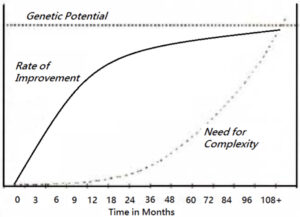
Well, as you are starting out the rate of adaptation is very high. Meaning that you can make the fastest gains that you’ll every make in your entire lifting career.
As you advance, it becomes harder and harder to make progress, until eventually, you are breaking a record maybe every 12 weeks if you are lucky.
The best way to take advantage of this process as a beginner, is to keep the program, reps, sets and exercises stable, and allow the changes each session to be an increase in the weight on the bar.
This means that you develop momentum in the training and become very good at a select amount of movement patterns.
As you advance, more complexity is required to mitigate fatigue.
So, there is in fact a time and a place for complexity as you advance, BUT complexity for the sake of complexity is not necessary.
Beginners, why are you using six or seven exercises in your program, with mainly machine based work?
There’s a problem using machines specifically in the context for beginners…
1 – Most machines won’t allow you to progressively overload and increase the stress for a long amount of time, maybe 6 weeks if you are lucky.
2 – They work muscles in isolation, meaning that you can’t produce a lot of force.
Why then, would you prioritise a machine over a barbell as a beginner?
Maybe if you are trying to modify one of the main movements because you do not have the stability to perform them safely, for instance a leg press for a squat, or a pulldown for a chin-up.
But outside of exercise modification, why?
As a strength competitor at more of an advanced level, it may be worth including more DB’s and machines in “the off season” to recover from heavier lifting and “emphasise” a particular weak muscle by providing more volume to that area. That could be an appropriate application of machine and DB work.
Or I can see their application for more advanced physique competitors.
But as a beginner? I don’t get it.
You only have so much time per day, surely you want to spend it on the stuff that really matters.
In that case, the barbell will always serve as the best tool for getting you started and building a base of strength.
The Simplest Way Can Often be the Hardest Way
This all boils down to the simple fact that people do not like to do hard things. If there is an excuse or an easy way out, some people will take that opportunity without a second thought.
Of course, asking someone to add 2.5kg to the bar, when the last session was really hard, is quite a daunting thing to do.
In so, they will go to the stability ball and make it easier.
They’ll do anything but the necessary work to get stronger and bigger.
The simplest way can often be the hardest way because it forces you to see the truth and confront it.
The barbell is your best friend in the gym, don’t avoid it, embrace it.